Leighton's SeaBack to the project shelf

Field study 03 · Infrastructure model

Visual CMDB

A desktop map of the homelab that distinguishes what is known, what is inferred, and what is merely being considered—down to ports, cables, power state, and silicon.

59mapped entities
154typed properties
13claims awaiting judgment
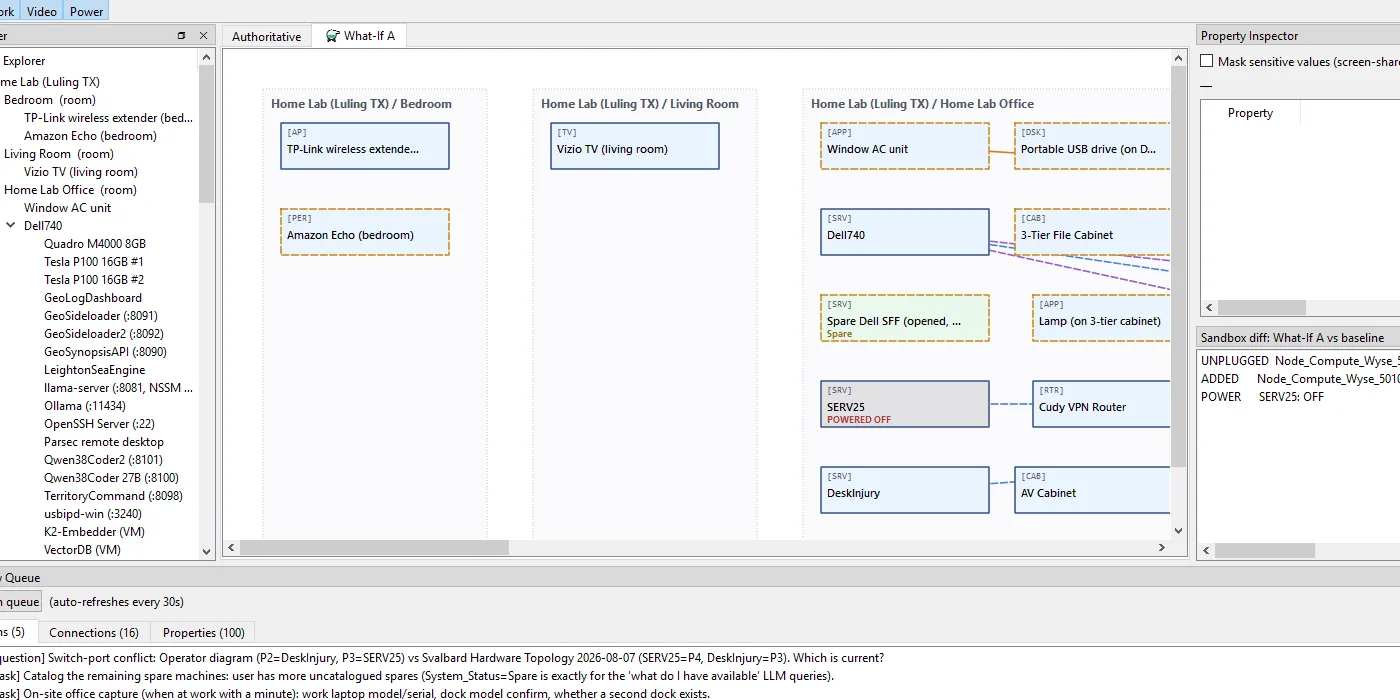
Visual CMDB canvas showing home-lab equipment grouped by physical room with generated device icons
The physical canvasEquipment is grouped by where it actually lives; types, status, ports, and relationships stay visible instead of disappearing into a spreadsheet row.

The ingenuity

A fact, a suggestion, and a hypothetical are three different things.

Most infrastructure diagrams flatten uncertainty. Visual CMDB keeps an authoritative baseline while imported observations arrive as claims with their own evidence and provenance. A human can confirm or reject them instead of letting automation silently rewrite reality.

Experiments use copy-on-write sandboxes. A proposed power move, network link, or device placement overlays the baseline and produces a readable diff. The real model stays untouched until the change is deliberately accepted.

  • 01Represent physical ports and connections as typed objects, not free-form notes.
  • 02Attach source and confidence to claims so discovery remains auditable.
  • 03Let overlays answer focused questions without duplicating the underlying inventory.
  • 04Export bounded views for local agents without exposing the entire operational picture.
01 / Two truths

Plan freely. Commit carefully.

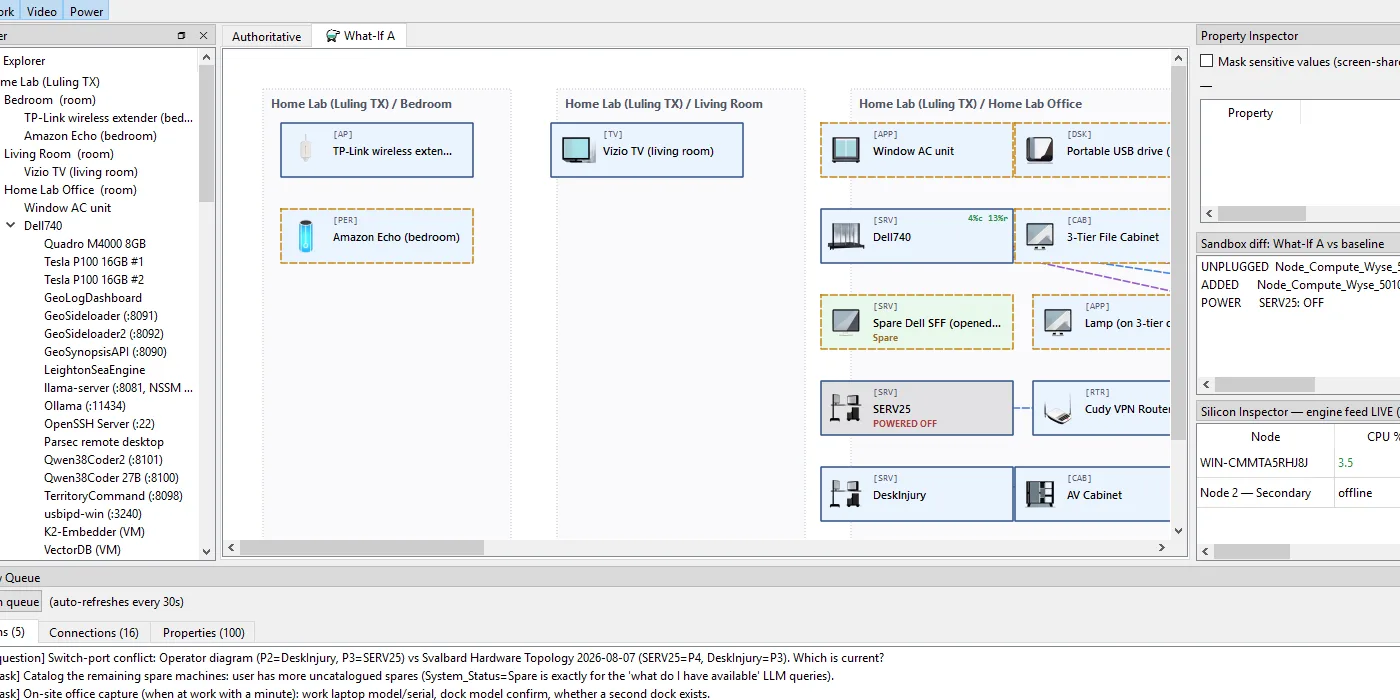
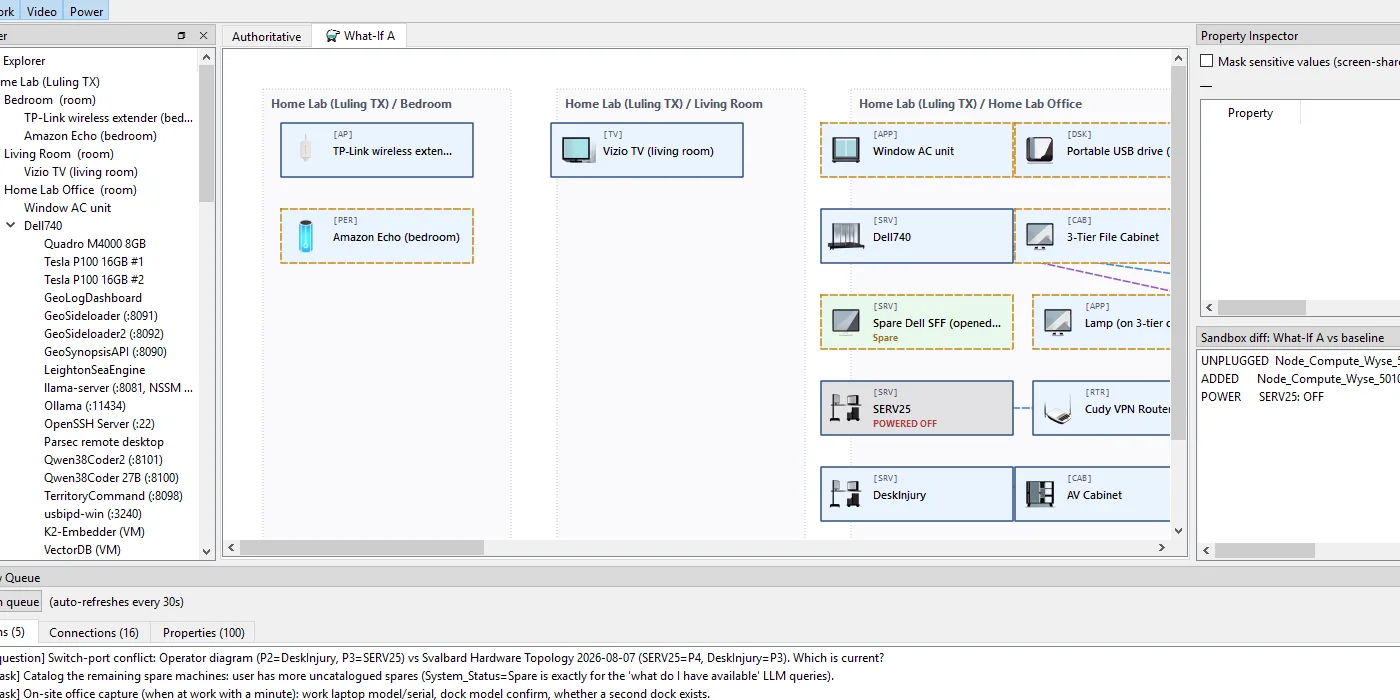
The sandbox uses the same topology grammar as the authoritative view, but dashed states and a generated change list make the proposed world visibly distinct.

Selective view. These crops retain enough of the real interface to show the model while excluding network addresses, credentials, serials, and detailed evidence panes.

02 / Layers

One model, several ways to reason over it.

ObserveImport inventory, telemetry, and human notes as sourced evidence.
ClaimQueue uncertain discoveries for explicit confirmation or rejection.
ModelStore entities, typed properties, ports, and physical links in SQLite.
OverlayAdd status, silicon, or question-specific context without rewriting facts.
SandboxSimulate changes and produce a diff before accepting any of them.

Small detail, big effect

The icon forge is part of the model.

Generic boxes make a topology technically accurate but visually slow. A local icon pipeline gives each device family a recognizable silhouette, then the UI adds semantic badges for type and state. The result is quicker to scan without turning the CMDB into decoration.

The same principle runs through the project: make important distinctions visible. Physical versus logical, known versus claimed, baseline versus hypothetical, and stable identity versus live telemetry each get their own visual language.